SNAP-8 Research: Octapeptide Mechanism and Skin Aging Models
Research guide to SNAP-8 (Acetyl Octapeptide-3) — how it mimics the SNAP-25 N-terminal sequence to study SNARE complex inhibition, its use in skin aging research models, and comparison with topical anti-aging peptide research.
Introduction: The SNAP-25 Target
SNAP-8's mechanism is rooted in neuromuscular junction (NMJ) biology. To understand how it works, it's necessary to understand the SNARE complex and SNAP-25's role in neurotransmitter release.
The SNARE Complex: Synaptic Vesicle Docking
The SNARE (Soluble NSF Attachment Protein Receptor) complex is the molecular machinery responsible for neurotransmitter release at synapses:
- Vesicle membrane SNARE (v-SNARE): Synaptobrevin/VAMP — located on synaptic vesicles
- Target membrane SNAREs (t-SNAREs):
When an action potential reaches the nerve terminal, calcium influx triggers SNARE complex assembly — the three proteins zip together in a four-helix bundle, pulling the vesicle membrane into contact with the presynaptic membrane and forcing exocytosis of the neurotransmitter (acetylcholine at the NMJ).
Why SNAP-25 is a Research Target
SNAP-25 has two structural regions that contribute to the SNARE bundle. The N-terminal region of SNAP-25 is particularly important for initial SNARE complex nucleation — this is the sequence that SNAP-8 mimics.
Botulin toxin (BTX) cleaves SNAP-25 at its C-terminal region, preventing SNARE assembly and blocking ACh release — this is the mechanism of cosmetic botulinum toxin. SNAP-8 works via a different mechanism: competitive inhibition of SNARE complex formation, not proteolytic cleavage.
SNAP-8: Mechanism of Action
Structure
- Full name: Acetyl-Glu-Glu-Met-Gln-Arg-Arg-Ala-Asp-NH2 (8 amino acids, N-terminally acetylated)
- Also known as: Acetyl Octapeptide-3, Leuphasyl
- MW: ~1075 Da
Mechanism
SNAP-8 mimics the N-terminal sequence of SNAP-25. By flooding the SNARE assembly interface with a competing fragment:- SNAP-8 occupies the nucleation site on syntaxin 1
- Full-length SNAP-25 cannot assemble into functional SNARE complex
- Catecholamine/ACh release is partially inhibited at the NMJ
- Muscle contraction at treated facial expression muscles is reduced
Shop Clavicular's Protocol
Research-grade Retatrutide and BPC-157 from our trusted research supplier — the exact peptides behind the most viral looksmaxxing transformation.
Skin Aging Research Applications
The Expression Line Biology
Facial expression lines (dynamic wrinkles) form through a different mechanism than photoaging wrinkles:
- Repeated muscle contraction at expression muscles (frontalis, orbicularis oculi, corrugator)
- Mechanical stress on the overlying dermis from years of repeated folding
- Collagen and elastin fatigue at skin fold lines
- Progressive deepening of lines as ECM repair capacity declines with age
In Vitro Research Models
Neuroendocrine cell line models (PC12, chromaffin cells):
- Measure catecholamine release by HPLC or fluorescence
- Dose-response characterization for SNARE inhibition
- Compare SNAP-8 to BTX effects at matched concentrations
- Apply cyclic mechanical strain to dermal fibroblasts
- Measure MMP upregulation, collagen synthesis inhibition under strain
- Test whether SNAP-8 (applied to co-cultured neurons) reduces the mechanical load transmitted to fibroblasts
Ex Vivo Skin Models
Reconstituted human epidermis (RHE) and full-thickness skin equivalents allow:
- SNAP-8 formulation testing in realistic skin architecture
- Penetration studies (small peptide, acetylation aids lipophilicity)
- Profilometry for surface texture quantification
- Gene expression changes in treated skin equivalents
SNAP-8 vs. Other Anti-Aging Peptides: Research Comparison
| Peptide | Target | Mechanism | Research Use |
| SNAP-8 | SNARE complex / NMJ | Competitive SNARE inhibition | Expression line models |
| GHK-Cu | Transcription factors / ECM | 300+ gene regulation | ECM restoration, broad aging |
| Matrixyl (Pal-KTTKS) | TGF-beta pathway | Collagen gene induction | Photoaging, ECM research |
| Argireline (Acetyl Hexapeptide-3) | SNARE complex | SNAP-25 N-terminal mimic (6AA vs 8AA) | Expression line — SNAP-8 extended analog |
| Leuphasyl | Enkephalin receptor | Reduces NMJ sensitivity | Often combined with SNAP-8 |
Note on Argireline vs. SNAP-8: SNAP-8 is an 8-amino acid version of Argireline (6 amino acids). Both mimic SNAP-25 N-terminal sequences, but SNAP-8 is proposed to have greater SNARE inhibition due to the additional two residues improving binding affinity.
Formulation Considerations for SNAP-8 Research
Penetration
SNAP-8 must reach dermal nerves and NMJs to exert its mechanism. Skin penetration of peptides is generally poor without delivery enhancement:- Molecular weight (1075 Da) is above optimal transdermal penetration range (<500 Da guideline)
- Acetylation improves lipophilicity vs. free N-terminus
- Research formulations typically use penetration enhancers (propylene glycol, oleic acid) or liposomal encapsulation
Stability
- Stable at pH 4-7
- Lyophilized powder: store at -20C; stable 2+ years
- In aqueous solution: stable 4-6 weeks at 4C; avoid repeated freeze-thaw
- Incompatible with strong oxidizers (methionine residue is oxidation-sensitive)
Pairing with GHK-Cu in Research
SNAP-8 and GHK-Cu address different components of facial skin aging:
- SNAP-8: Reduces mechanical contribution from muscle contraction (NMJ inhibition)
- GHK-Cu: Restores ECM integrity, collagen synthesis, and anti-inflammatory signaling
SNAP-8 and GHK-Cu 50mg available from Apollo Peptide Sciences — for laboratory research only.
Build Clavicular's Stack
Research-grade Retatrutide + BPC-157 from our trusted research supplier. The exact protocol behind Clavicular's viral looksmaxxing transformation.
Featured Products
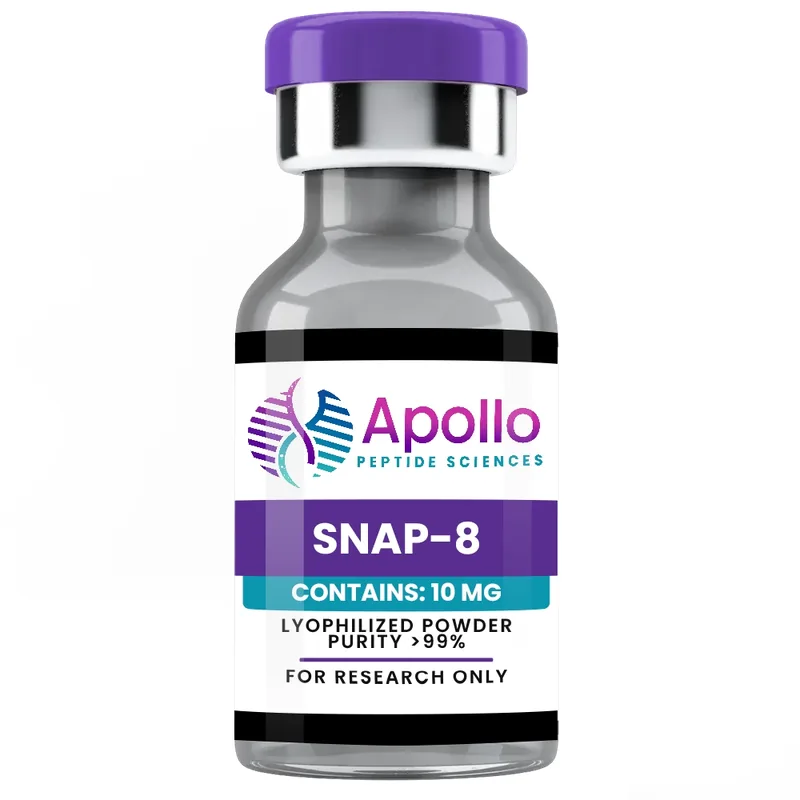
SNAP-8
SNAP-8 is a synthetic octapeptide (Acetyl-Glu-Glu-Met-Gln-Arg-Arg-Ala-Asp-NH2) that mimics the N-terminal end of SNAP-25, a substrate protein in the SNARE complex involved in synaptic vesicle docking. Research models use SNAP-8 to study inhibition of catecholamine release at the neuromuscular junction, which may reduce repetitive muscle contractions implicated in expression line formation. Frequently studied in topical formulation models alongside GHK-Cu.
CAS: 868844-74-0
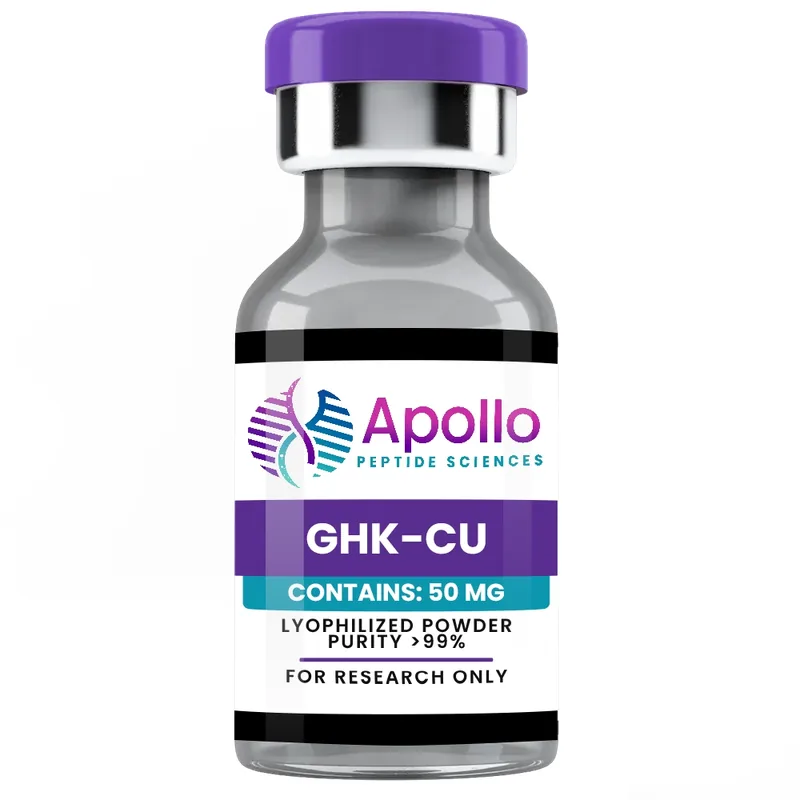
GHK-Cu 50mg
GHK-Cu (glycyl-L-histidyl-L-lysine copper complex) is a naturally occurring copper peptide present in human plasma, saliva, and urine that declines significantly with age. Extensively studied for wound healing, collagen synthesis, anti-inflammatory signaling, and skin remodeling. Research has documented upregulation of over 300 genes and downregulation of 190+ genes implicated in aging. Often researched alongside Epithalon in longevity stacks.
CAS: 49557-75-7